
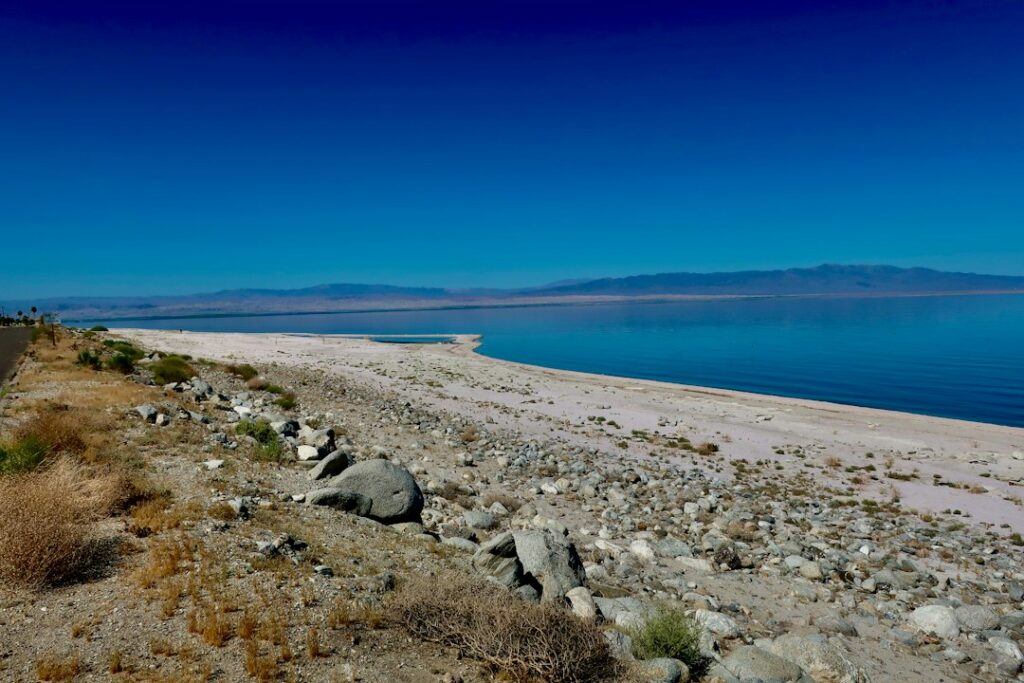
SALTON SEA, Imperial and Riverside Counties — October 27, 2026. California’s largest inland lake is at the center of one of the state’s most expensive, complicated and urgent environmental undertakings. The state wants to suppress hazardous dust, rebuild places for fish and migratory birds, and make shoreline communities more livable. The federal government has tied major restoration support to Colorado River water conservation. Meanwhile, companies are pursuing lithium beneath the southern shoreline and residents want to know whether the promised public benefits will arrive before the next round of ecological damage.
Our central finding: real restoration is finally visible at the Salton Sea, but the official record remains much more mixed than either a declaration of failure or a victory announcement would suggest. The state’s public project dashboard, reviewed for this report, lists $589 million committed to the Salton Sea Management Program, 4,782 acres in its combined completed-and-interim-dust-treatment category, 7,937 acres in construction, 5,551 in design and 11,530 in planning, toward a 29,800-acre 2028 program objective. The $589 million is a commitment measure, not a verified accounting of money already spent, and interim surface treatment is not equivalent to a finished permanent ecological restoration project.
California58 examined State Water Board orders and milestone tables, the Salton Sea Management Program’s interactive dashboard, federal funding announcements, the governor’s 2026 conservancy launch, university research on children’s lungs, public county planning documents and reporting on the lithium industry’s delays. We have not conducted independent sediment sampling, interviewed each contract recipient, reviewed every voucher or completed a forensic audit. Where the available public record does not answer a question, we say so rather than suggest wrongdoing without evidence.
1. What is the Salton Sea — and why is it disappearing?
The Salton Sea is a terminal saline lake in a below-sea-level desert basin: water enters, but it has no river outlet to the ocean. Although the basin held lakes at earlier periods, the modern Salton Sea formed after Colorado River flooding and irrigation-system failures in 1905–1907. In the century since, its surface depended heavily on agricultural drainage, with the State Water Board saying roughly 80 percent of its inflow has come from Imperial Valley farming areas.
That dependence produced a structural contradiction. California and water agencies have legitimate reasons to conserve scarce Colorado River supplies and transfer water to urban users, but reduced irrigation runoff also means less water reaching the lake. Evaporation concentrates salts and nutrients. As the shoreline retreats, sediment that spent decades underwater becomes an exposed source of potentially windblown particles. The State Water Board says the Sea is more than twice as saline as the ocean, and nutrient-driven algal conditions can deprive aquatic life of oxygen. Its ecological decline also affects the Pacific Flyway, on which migratory birds rely.
This is not a lake that can be repaired by dredging a harbor or cleaning a swimming beach. A durable strategy must grapple with water balance, salinity, the quality of incoming water, air pollution, wildlife habitat, upstream water rights, public health and long-term operating costs at the same time. The State’s existing near-term program primarily manages the consequences of recession rather than promising to refill the entire historic lake.
Record: California State Water Resources Control Board — Salton Sea background, orders and workshops.
2. The water bargain: who receives Colorado River water and who inherits the consequences?
One of the most consequential events occurred long before today’s construction machinery arrived. The State Water Board’s 2002 water-rights orders authorized long-term transfers of up to 300,000 acre-feet annually from the Imperial Irrigation District (IID), including up to 200,000 acre-feet to the San Diego County Water Authority and up to 100,000 acre-feet to the Coachella Valley Water District and Metropolitan Water District, under the framework that became the 2003 Quantification Settlement Agreement (QSA).
Those are authorized long-term transfer quantities in the orders, not a measurement of the number of acre-feet transferred in October 2026. The QSA included an initial period of mitigation flows; the end of the dedicated mitigation-water period at the end of 2017 helped make the consequences of less incoming water even harder to ignore. Additional Colorado River conservation and post-2026 operating decisions may further influence conditions.
The governing question has never been simply whether Southern California should conserve water. It is who bears the costs when conservation reduces the runoff that had sustained an ecosystem and shoreline settlements. Residents of Salton City, Desert Shores, Mecca, North Shore, Niland, Bombay Beach, Calipatria and other Imperial and Coachella Valley communities should be able to see how air-quality mitigation and long-term environmental obligations are funded alongside the water savings.
The State Water Board has authority over specified water-right conditions and restoration milestones, but multiple agencies divide responsibility for projects, public health, local land use and monitoring. This divided structure makes public accountability harder unless reports use comparable measures and name a responsible agency for each commitment.
Record: State Water Board water transfer orders and 2017 restoration order.
3. The promise written into a state order: 29,800 acres by 2028
In November 2017, the State Water Board adopted Order WR 2017-0134. It set a sequence of cumulative acreage milestones for habitat restoration and dust suppression. They are not promotional targets invented by a politician’s press office; they appear in a formal public regulatory order, and the board requires annual reports and public workshops to review progress.
| End of year | Cumulative acreage milestone in state order | Interpretation |
|---|---|---|
| 2023 | 11,500 acres | Scheduled cumulative work |
| 2024 | 14,200 acres | Scheduled cumulative work |
| 2025 | 17,600 acres | Scheduled cumulative work |
| 2026 | 21,600 acres | End-of-year target; not proof of delivery |
| 2027 | 25,600 acres | Future cumulative target |
| 2028 | 29,800 acres | End-of-program Phase I target |
As of our review in late October 2026, the state dashboard’s 4,782-acre interim-or-complete category represents only about 16 percent of the overall 29,800-acre goal. Another 7,937 acres are classified as in construction, but construction is not equivalent to completed, operating habitat or stable, permanently controlled dust. The dashboard also counts 5,551 acres in design and 11,530 in planning. These four categories add to the overall program area in its published snapshot; they must not be added to other overlapping category subtotals from the same tracker.
Comparing 4,782 acres to a year-end target is not a substitute for the State Water Board’s legal compliance analysis: the categories include interim work, the tracker can be updated on a different schedule than the annual board report, and the precise definition of eligible acreage matters. But the gap raises an unavoidable public-interest question: How many acres will the board recognize as fully meeting the annual obligation by December 31, 2026, and what schedule cures any shortfall?
Under the 2017 order, reporting must identify milestones, money and permits not yet secured, anticipated departures and plans to cure significant shortfalls. Those accountability provisions should be actively used, not merely mentioned at annual ceremonies.
Records: 2017 order and annual targets · SSMP dashboard and definitions of acres.
4. What has actually been built?
There are functioning and partially constructed projects. The largest is the Species Conservation Habitat (SCH) Project at the southern end of the Sea. Its system of managed ponds, berms, water-delivery channels and islands is intended to support fish and birds while covering portions of formerly exposed lakebed. The governor’s April 2026 announcement said the expanded SCH footprint is envisioned to reach 9,400 acres. That is the envisioned full area, not proof that 9,400 acres were complete in April or October.
The dashboard lists 2,357 acres of completed fish-and-wildlife habitat construction and a further 7,643 acres in construction in that habitat category. These are category-specific metrics and should not be double-counted with the overall totals. The dashboard separately reports interim surface roughening, vegetation enhancements and dust control around places such as Clubhouse, Tule Wash, New River and West Bombay Beach.
The state publicly described pond filling in 2025 and said fish and birds were observed using new habitat. That is encouraging evidence of ecological function, but long-term outcomes require continuing monitoring of salinity, water quality, nesting, survival, dust suppression and maintenance. A newly filled pond does not guarantee decades of dependable water or habitat value.
Some locations are further behind. At the north shore, the North Lake Pilot Demonstration Project remains classified as Planning/Design in the official tracker. It envisions about 70 acres, including wetlands and shallow-lake habitat near the North Shore Beach and Yacht Club Community Center, and its record mentions a $19.25 million Proposition 68 funding agreement from 2021. A separate broader North Lake Planning Area is explicitly conceptual. An allocated project budget should not be confused with an existing public lake or reopened marina.
Records: SSMP progress dashboard · Governor’s April 10, 2026 SCH update · North Lake Pilot official project fact sheet.
5. Follow the money: $589 million does not mean $589 million spent
Salton Sea financing is a mixture of state appropriations, bond funds, federal contributions, grants and project-specific commitments. The statewide dashboard displays $589 million in funds committed to the program. This is not a line-by-line cash expenditure report and should not be interpreted as every dollar having reached a contractor or been converted into completed acreage.
Federal assistance became a major part of the story after the 2022 Inflation Reduction Act. The Bureau of Reclamation announced up to $250 million in support connected to mitigation and water conservation. Federal materials describe an initial $70 million for California habitat construction and $2 million for Torres Martinez Desert Cahuilla tribal technical capacity, with additional funds conditioned on further Colorado River conservation. The state’s earlier annual reporting described approximately $245 million in Reclamation funding commitments between 2023 and 2025. These are overlapping descriptions of the same federal funding stream; they are not separate pots to be casually added to the $589 million dashboard figure.
The distinction matters especially in a grant application or sponsorship proposal. Committed, appropriated, obligated, contracted, disbursed and spent are not interchangeable words. Nor is a project cost estimate the same as audited cost-to-completion. For an actual procurement-level audit, California58 would need current agency ledgers, grant agreements, invoices, construction change orders, audited financial statements and project-by-project balances.
Public documents do offer starting points. The state tracker allows project status comparisons; the Natural Resources Agency’s Salton Sea unit links program expenditure records; State Water Board proceedings require periodic funding reports. The Bureau of Reclamation explains the federal conservation and restoration connection.
The financial questions agencies still need to answer clearly
- How much of the $589 million is legally obligated, under signed construction contracts, actually disbursed and supported by completed deliverables?
- What portion is restricted to a specific shoreline, habitat function, tribe, water-saving agreement or grant period?
- Which projects face cost increases, schedule delays, permit problems or expired grant periods?
- What is the annual cost to operate and maintain the new ponds and dust-control projects for 10, 20 and 30 years, and who will pay it?
- What portion of funding demonstrably improves conditions in the most exposed residential communities?
These are questions arising from fragmented public records; they are not allegations of theft, fraud or misuse.
6. A dangerous contradiction: water conservation can expose more hazardous dust
For the broader Southwest, conserving Colorado River water is essential amid ongoing drought, demand and changing hydrology. But the Salton Sea exposes a regional consequence of doing so without fully financing mitigation. Reduced water reaching the basin can leave more lakebed exposed, some of which contains salts, accumulated agricultural inputs and naturally occurring contaminants.
What is known: The California State Water Board identifies dust from the exposed playa as a public health hazard. The region also suffers from other air pollution sources, including agricultural activity, desert dust, traffic and industry, so not every unhealthy air day can be attributed exclusively to the Salton Sea. Treatment of the playa should be evaluated through independent ambient monitoring and documented emission reductions rather than a claim that a specific community’s asthma problem has been solved.
Researchers have moved the discussion beyond general concern. In an October 14, 2025 announcement, University of California, Irvine described a study linking higher windblown dust exposure near the Salton Sea with poorer lung-function measurements in children. The results are important, but an epidemiological association does not establish that all individual illnesses were caused by lakebed dust, nor provide a parcel-by-parcel estimate of exposure.
Communities deserve monitoring that measures particles where people live, clearer evidence about the chemistry and source of dust, accessible public warnings, and rigorous evaluation of whether restoration projects reduce exposure. Independent researchers and residents should be able to obtain the data underpinning progress claims.
Records: UC Irvine — children’s lung-function research · State Water Board air-quality context.
7. Lithium Valley: another proposed economic transformation beneath the same shoreline
The Salton Sea region also sits above geothermal brine rich in lithium, a mineral used in batteries. A 2023 U.S. Department of Energy-supported Lawrence Berkeley National Laboratory assessment identified an exceptionally large potential resource. Officials have publicized estimates up to 18 million metric tons in the geothermal resource region, but resource estimates are not the same as recoverable, permitted or commercially produced lithium.
An important distinction is geographical: lithium extraction proposals involve hot brine from a deep geothermal reservoir, not the pumping of lithium directly out of the surface Salton Sea lake. Imperial County expressly says there is no direct physical or hydrologic connection between the geothermal reservoir and the lake itself. Development could still affect local water demand, groundwater, energy, truck traffic and air quality, so the absence of direct connection is not a finding of zero community impact.
The county has studied a Lithium Valley Specific Plan and Program Environmental Impact Report covering roughly 51,000-plus acres near the southeastern shore. Its public review period was extended into April 2026 following community and agency requests. That is planning and environmental review, not proof that the entire region has been authorized for immediate development.
In August 2026, the county adopted the Lithium Innovation and Competitiveness (LiNC) Program on a 3–2 vote. The county explicitly describes this as a performance-based incentive arrangement involving possible reimbursement from certain future project-generated taxes. It is not an upfront grant or cash giveaway. Any resulting revenue or incentive should be tracked only after a qualifying project actually produces the relevant taxable activity and meets the requirements.
The economic promise is substantial: local jobs, skilled training, industrial suppliers, a larger tax base and a place in the domestic battery industry. The uncertainties are just as real. Projects have experienced regulatory, litigation, capital and technology challenges. A September 2026 CalMatters investigation reported that commercial extraction remained behind early promises and that an appellate decision required corrections to environmental review addressing water and air-quality issues for the Hell’s Kitchen project. That procedural development is not a general ban on all lithium projects and not a ruling that lithium extraction is inherently impossible.
Sources: U.S. Department of Energy’s lithium resource overview · Imperial County geothermal reservoir clarification · Imperial County LiNC adopted program · CalMatters September 2026 project and litigation reporting.
8. Environmental justice: whose voice counts when projects are designed?
The shoreline is not an empty piece of land awaiting a clean-energy and restoration experiment. It contains longstanding tribal communities, farmworker families, small businesses, residents of unincorporated settlements and culturally important landscapes. The Torres Martinez Desert Cahuilla Indians have direct sovereign and community interests. Restoration cannot be judged solely from a contractor map or a photograph of a filled pond.
Meaningful participation requires meetings accessible to residents across Imperial and Riverside Counties, interpretation and translated records where needed, early visibility into land access and construction decisions, community-friendly monitoring information, and independent review of health outcomes. The State Water Board’s May 20, 2026 annual workshop offered in-person and online participation with English and Spanish access. That creates a route for testimony, although a hearing alone is not evidence that every concern is addressed.
Projects can affect communities differently: the South Sea’s habitat ponds, Bombay Beach shore treatments, Desert Shores proposed channel work and the North Lake pilot do not share the same implementation status, costs or anticipated benefits. County-level averages can obscure those differences. The real test is whether the region’s poorest and most exposed neighborhoods can document improving conditions.
The federal restoration agreements also include funding to strengthen Torres Martinez tribal technical capacity. That is not the same as treating the tribe as a project subcontractor; government-to-government responsibilities and consultation obligations remain distinct.
Records: State Water Board annual workshop and community documents · individual project tracker.
9. A new Salton Sea Conservancy in 2026 — what does it actually change?
On April 10, 2026, the governor announced the Salton Sea Conservancy, created under legislation authored by state Sen. Steve Padilla. Its stated purpose is to strengthen long-term stewardship, operations and maintenance of habitat investments, protect public health and support community access. The new body is an important institutional development, especially because construction alone cannot make an engineered pond sustainable.
It also raises governance questions. The California Natural Resources Agency, Department of Water Resources, Department of Fish and Wildlife, State Water Board, Salton Sea Authority, U.S. Bureau of Reclamation, Imperial Irrigation District, tribal governments, counties and now the Conservancy all play different roles. A new organization could improve coordination, but it could also create another layer for residents to navigate if agencies do not publish a clear responsibility map.
A launch ceremony is not a water-delivery guarantee. Residents need to know which projects the Conservancy will maintain, when oversight transfers, where the operating budget comes from, whether decisions and procurement are public, and how problems such as dust-emission exceedances will be addressed.
Source: California Natural Resources Agency — April 2026 Conservancy launch.
10. Does anyone plan to refill the entire Salton Sea?
Plans have considered different combinations of habitat ponds, wetlands, shoreline dust treatments, engineered water movement and longer-range restoration concepts. But the operative near-term state strategy does not promise to refill the Sea to its historic shore, restore all recreational boating or recover the old salinity profile in the entire basin. It is more precise to describe habitat construction and dust-mitigation projects at a shrinking lake than to advertise a complete reversal of the water balance.
The Final Long-Range Plan, developed for the period after 2028, feeds into a federal U.S. Army Corps of Engineers feasibility study. A feasibility study weighs options, costs, benefits and federal requirements; it is not itself an appropriation for building the selected alternative. The Salton Sea Authority’s 2026 meeting agendas show continuing discussion of financing, federal participation and maintenance commitments.
Any very large-scale refill plan would need a sustainable, lawful and affordable water supply and would have to address the cost of energy, conveyance, salinity, environmental review, long-term pumping and effects elsewhere. The public should not mistake a proposed concept, lobbying request, feasibility contract or media rendering for a financed project.
Records: Water Board long-range plan and study references · Salton Sea Authority March 2026 board agenda.
11. What should taxpayers and grantmakers demand before celebrating results?
California58 proposes a straightforward public-accountability scorecard for every material project in the SSMP portfolio. It should show: the affected community; legally obligated acreage; design and permit status; promised construction date; revised schedule; the funding source; amounts appropriated, awarded, contracted and actually spent; the contractor; any change orders; baseline dust and water-quality measurements; seasonal water requirements; maintenance commitments; and independently verifiable outcomes.
That is also how responsible philanthropy should approach the crisis. Independent journalism, multilingual translation, community listening, environmental-health data interpretation and public-records analysis can be legitimate public-interest activities. But a newsroom applying for a grant must distinguish its own editorial project budget from the government’s restoration budget and must never suggest that government conservation grants belong to California58.
For California58: this article is part of the network’s public-interest reporting initiative. No public restoration award, private sponsorship or grant for this story is being claimed. Editorial decisions, sources and corrections remain independent of future sponsors, and a financial contribution would not buy the right to edit findings or approve coverage.
12. Questions we are asking the agencies
- California Natural Resources Agency / DWR: Of the $589 million dashboard commitment, how much has been disbursed as of the most recent fiscal report, and which contract line items account for the difference?
- State Water Board: What acreage will officially count toward the 2026 cumulative 21,600-acre order milestone, and what compliance or cure mechanisms apply to any shortfall?
- Bureau of Reclamation: Which portions of the originally announced up-to-$250-million federal arrangement are fully obligated, expended, or still conditional?
- IID and water districts: What inflow and conservation assumptions are used in state project designs, including the period after the new Colorado River operating rules take effect?
- Salton Sea Conservancy: Which entity carries the permanent responsibility and funding for pond operations, dust treatments and public access?
- Imperial County and lithium developers: What water-source, air-quality and employment commitments are enforceable, and how will local communities verify results?
- Air-quality agencies and public-health departments: Where can residents see comparable monitoring data and before-and-after evaluations of individual mitigation projects?
- Local and tribal governments: Which community priorities were incorporated into project design, and what changes were requested but not adopted?
The questions are published to invite on-the-record responses, supporting documents and corrections. The absence of a response in this document should not be interpreted as a refusal by any agency: California58 has not represented that a new formal records request or interview has already been sent as part of this publication.
13. An honest verdict in October 2026
It would be false to say nothing has happened. The state has built habitat, expanded shoreline treatments, attracted funding and established a new conservancy. It would be equally false to claim that the Salton Sea is restored. The project’s official dashboard still shows the majority of the 29,800-acre 2028 area in construction, design or planning. Water scarcity remains a systemic challenge. Public health research underscores the cost of delay, and lithium development promises an economic future that has not yet become a mature production industry.
The investigation’s conclusion is an accountability gap, not a proven corruption scheme. The public can identify regulatory obligations, funding announcements and project-stage counts; it cannot from those high-level numbers alone determine cost effectiveness, contract-level expenditures or long-term health outcomes. The next standard of transparency should be a clear, regularly refreshed link between dollars actually spent, acres functioning, measured air improvement and benefits received by named communities.
Salton Sea residents deserve more than a recurring choice between optimistic press releases and alarming photographs. They deserve reliable water planning, breathable air, restored habitat where feasible, employment promises that can be verified and an open financial record explaining what the public has already paid for and what remains unfinished.
Local newsrooms: six community investigations
The statewide Salton Sea crisis looks different from one shoreline community to another. These original California58 reports focus on the local facts and sources that matter most in each area. They are separate community reports, not duplicated copies of this investigation.
- Mecca / North Shore: What happened to the $19.25 million North Lake pilot?
- Niland: Which southern-shore habitat projects are really finished?
- Calipatria: The Lithium Valley plan, future tax incentives and employment promises
- Brawley: What UC Irvine found about dust and children’s lung function
- Thermal: The new Conservancy and the North Shore’s unresolved questions
- Coachella: The Colorado River water-transfer bargain and the Sea
More reporting published October 27: community projects and local accountability
California58’s latest original reporting follows individual questions that the statewide Salton Sea acreage totals cannot answer. Each community article links to its own source documents; these are not cloned versions of the main investigation.
- Salton City / Desert Shores: the completed $250,000 community park investment
- Desert Shores Marina: five proposed refilled channels remain in the state’s design-stage record
- Salton Sea colonia communities: 2026 infrastructure master plan process
- Salton City: the priorities residents raised in the state’s community-needs meeting
- Mecca / North Shore: 2026 climate grant application for solar and resilience center
- Mecca–North Shore: buffered bicycle lanes proposed along Hammond Road and Avenue 70
- Mecca / North Shore: updated 2026 first-time homebuyer income limits
- Niland / Bombay Beach: wetland restoration project’s documented design status
- Niland: long-term Salton Sea State Recreation Area plan
- Niland: housing rehabilitation and county CDBG programs
- Imperial County: a public-finance check on property-tax projections and audits
- Imperial County: court-ordered reversal of a temporary data-center moratorium
Primary documentation and reporting trail
- Salton Sea Management Program — current project dashboard (funding, acres and stages)
- California State Water Resources Control Board — orders, annual reporting and 2017–2028 milestones
- California Natural Resources Agency — Salton Sea Conservancy (April 10, 2026)
- U.S. Bureau of Reclamation — federal restoration funding and water conservation
- UC Irvine — windblown dust and children’s lung function
- U.S. Department of Energy — geothermal lithium resources and technology
- Imperial County — August 11, 2026 lithium incentive program
- Imperial County — Lithium Valley planning, technical resources and geothermal reservoir explanation
- CalMatters — September 2026 independent review of lithium project delays and environmental litigation
- SSMP — North Lake Pilot fact sheet
Methodology and corrections: Original California58 document-based analysis; official public records and the sources listed above reviewed October 27, 2026. Key calculations use the dashboard’s published categories as displayed, which may change as the state revises project records. We distinguish proposed projects, contracts, commitments, completed work, assumptions and independently demonstrated outcomes. We did not independently conduct lab tests or audit financial transactions. Request corrections and submit documents to california58com@gmail.com. See Editorial Standards, Sources & Corrections and Local Newsroom Charter.
Regional California58 newsrooms: Salton City News · Mecca News · Niland News · Calipatria News · Brawley News · Coachella News · Thermal News.
Independent editorial special report by California58 News. Original analysis of public documents; not a claim of original interviews, field investigations, audit access or a government affiliation. Published October 27, 2026.
Help this community newspaper grow
Your support helps build coverage for the people and places this local newspaper serves.
Donate once by card ↗Support Salton City News
Choose how to support Salton City News:
Credit / Debit Card via StripeChoose an amount from $1. One-time support through the publisher's LINKERNO Stripe account.
Continue with PayPal Continue with ZelleZelle payments go to Vitaly Ataev Troshin. Please verify the recipient in your bank before sending. Availability depends on your bank.
Optional reader support. When possible, add “Salton City News” to the payment note. Contributions are not advertised as tax-deductible. Support does not influence editorial decisions.More from Salton City News
- What Salton City Residents Asked For: State Community Feedback Put Transportation Ahead of Everything Else →
- Why Imperial County Classifies Salton Sea Communities as Colonias—and What a 2026 Plan Update Could Change →
- Desert Shores Marina: Five Channels Were Proposed for Refilling, but State Still Lists Project in Design →
- Desert Shores Soccer Park: Imperial County Reports $250,000 Greening Project Completed →
- Salton City Air Quality: California’s 2026 Monitoring Plan Includes a Local Station →
COMMUNITY
Comments
Join the California58 conversation. You must be signed in to comment.
Create a free California58 account or sign in with an available social provider.